
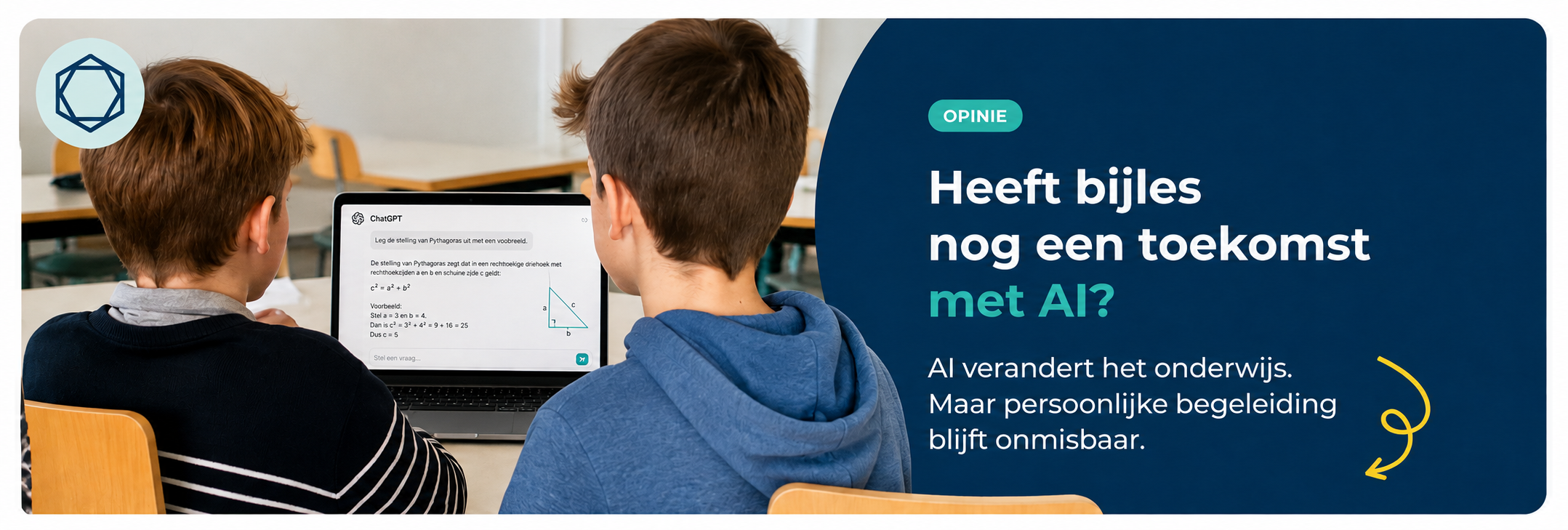

Does tutoring still have a future with AI?
Today, AI can summarize, solve exercises, and answer almost any student's question. Does tutoring still have a future? We believe it does. Not in spite of AI, but precisely because of it.
I can't count how many times I've been asked this over the past few years: “Does tutoring actually have a future with AI?”
I completely understand where that question comes from. A student who used to get stuck on a math problem had to wait until the next class, ask a fellow student, or search for an explanation on Google or YouTube. Today, that same student can take a photo of the exercise, feed it to ChatGPT or another AI tool, and ask for a full explanation seconds later. That changes the way we learn. And honestly, that’s fantastic.
But does it also mean that an AI chatbot will soon replace the tutor ? I don't think so.
AI is a great tool for learning
Let’s be clear: at Eduvik, we are not at all against students using AI. On the contrary. Students need to learn how to work with the tools available today. Knowing how to use AI for learning, how to ask a good question, and how to verify if an answer is correct are becoming increasingly important skills.
Moreover, we notice that it’s not just students using AI. Tutors are doing it more and more as well. I personally use AI in various ways during my preparation. Sometimes I ask for a brief summary of a topic to refresh my memory on the terminology from a student's course. Sometimes I have it solve an exercise to quickly check my own answer. And yes, AI can also save quite a bit of time when writing lesson summaries. Even this blog post received some help from AI along the way. And there is nothing wrong with that.
AI is a tool. Those who learn to use it well can save an incredible amount of time and often even learn better because of it.
But making information available is not the same as teaching
The interesting thing is that we have actually had this discussion before. Not about AI, of course.
When people started writing thousands of years ago, we were suddenly able to preserve knowledge without someone having to pass it on personally.
Around 1450, the printing press made it possible to distribute knowledge on a much larger scale. And from the 90s onwards, the internet gave us access to an almost endless amount of information from our own living rooms. Yet, teachers and tutors didn't disappear. On the contrary.
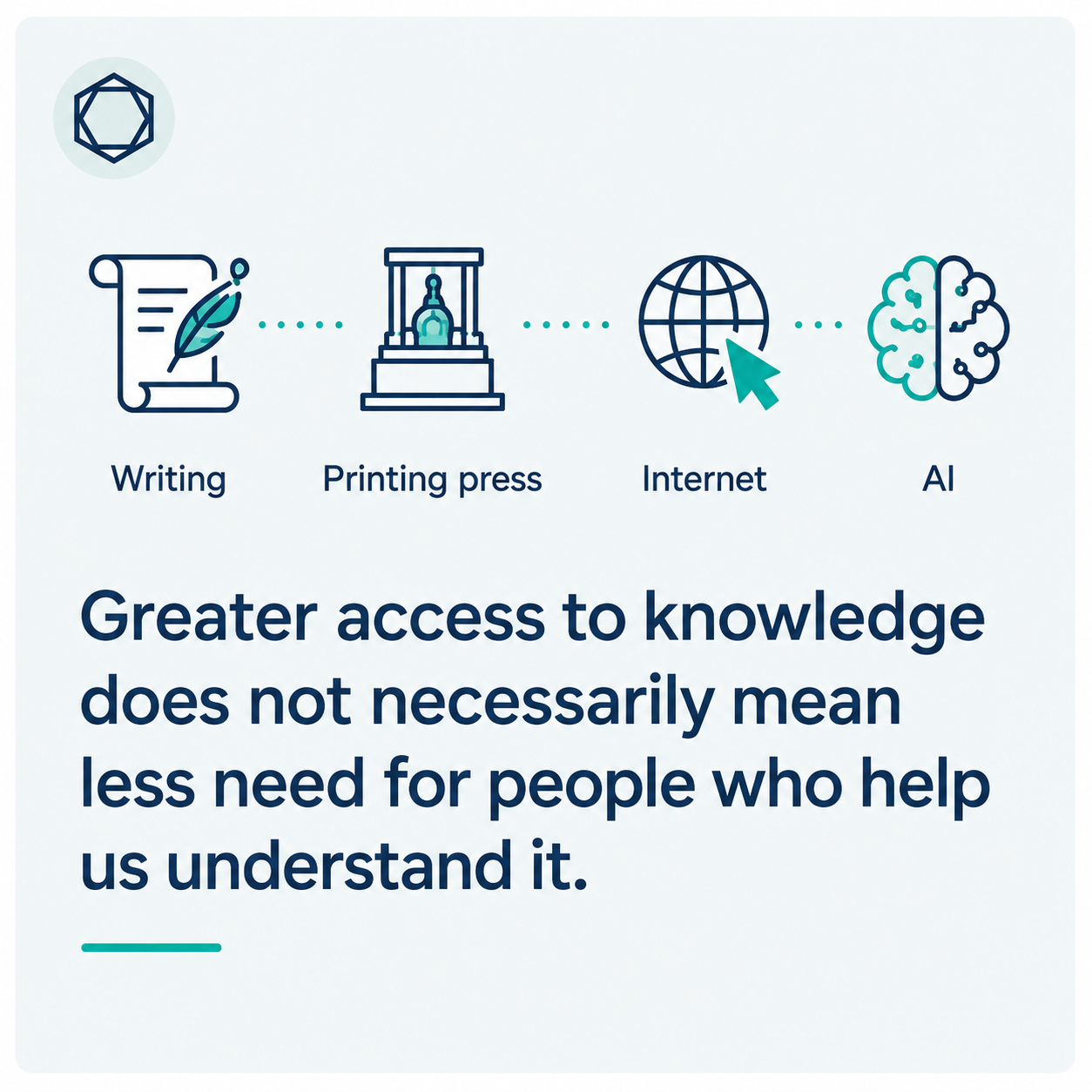
Information became increasingly accessible, but helping someone truly understand something turned out to be something entirely different than just making information available.
AI is now shifting that evolution into a higher gear. It makes information accessible faster, more personally, and more interactively than ever before. But even that doesn't automatically make guidance obsolete.
A student often doesn't know where they are getting stuck
Ask ChatGPT to explain the Pythagorean theorem and you will get a correct and comprehensive explanation within seconds. Useful.
But a personal tutor does something different during a lesson. They notice when a student starts to hesitate after ten seconds. That they make the same mistake with every equation. That the theory is actually understood, but things go wrong as soon as the exercise looks just a little bit different. A good tutor can then stop and ask:
“Wait a minute. How would you start this yourself?”
And suddenly it becomes clear that the problem isn't with Pythagoras at all, but, for example, with rearranging an equation. That difference is huge.
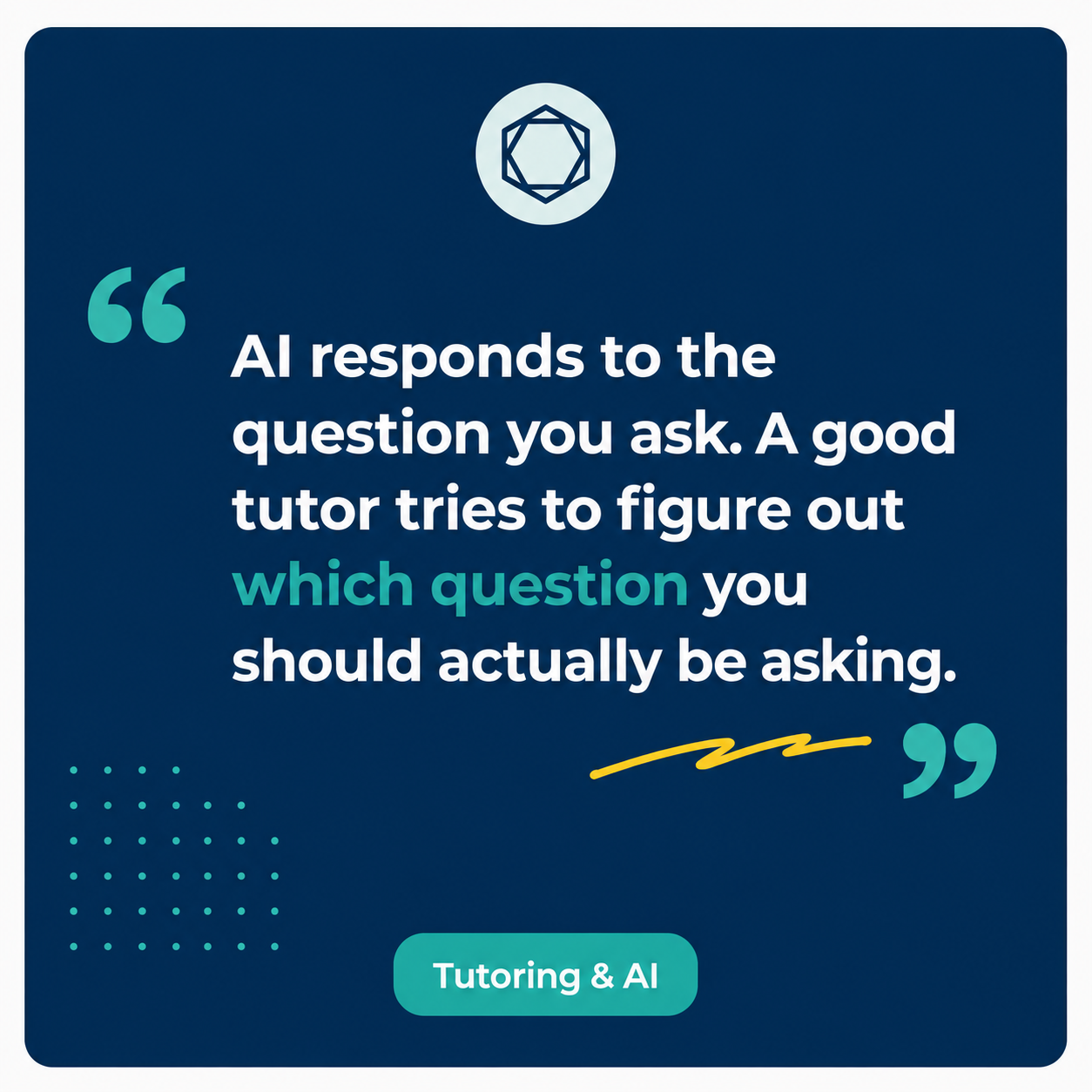
AI mainly responds to the question you ask. A good teacher first tries to figure out what question you should actually be asking.
In my opinion, that is one of the biggest reasons why personal tutoring remains relevant.
Sometimes AI even gives too much explanation
Anyone who regularly uses AI to learn something new will recognize this. You ask a simple question and get six paragraphs of explanation, three examples, a table, and five more possible next steps. Technically, that is impressive.
For a student who is already overwhelmed by their course material, it is sometimes the exact opposite of what they need. A tutor can say:
“Forget the rest for a moment. For your test today, you only need to understand this.”
Effective teaching isn't just about providing as much knowledge as possible. It's also about filtering, structuring, and presenting information at the right time. And sometimes, that means consciously providing less explanation.
Those seeking support can also choose between online or in-person tutoring via Eduvik, depending on what works best for the student.
Learning remains a human endeavor
There is another reason why I don't believe virtual tutors will simply replace humans: we enjoy learning from other people.
That isn't just a romantic notion. Research into social learning shows that human knowledge acquisition is deeply embedded in interaction with others. We don't just learn from other people, but also with other people. A review study by researchers from institutions including University College London describes how social interaction plays a key role in the way we acquire new knowledge (more info).
A tutor therefore provides more than just an answer. They can notice when a student is becoming insecure. Crack a joke when frustration mounts. Offer a compliment when something finally clicks. Or, after three exercises, say:
“See? You actually can do this.”
That little sentence might not be in the curriculum anywhere.
But for some students, it is exactly what they need at that moment.
And what about mathematics? AI is getting better at that at lightning speed.
If I had written this blog a year ago, it would likely have contained a fairly simple warning.
AI models are probabilistic systems. This meant that in exact sciences like mathematics and physics they could sometimes produce a completely wrong answer very convincingly. A calculation error, a false assumption, or even a fabricated line of reasoning could be wrapped in an explanation that sounded perfectly credible. That problem hasn't disappeared. But progress is moving at breakneck speed.
In 2024, specialized systems from Google DeepMind already reached the level of a silver medal at the International Mathematical Olympiad. In 2025, it went a step further: an advanced version of Gemini Deep Think officially achieved the level of a gold medal at the International Mathematical Olympiad (more info). The model completely solved five out of the six extremely difficult Olympiad problems.
And in May 2026, AI took another step forward. An AI model from OpenAI refuted a major conjecture within the nearly 80-year-old unit distance problem by Paul Erdős (more info). The proof was subsequently verified by external mathematicians.
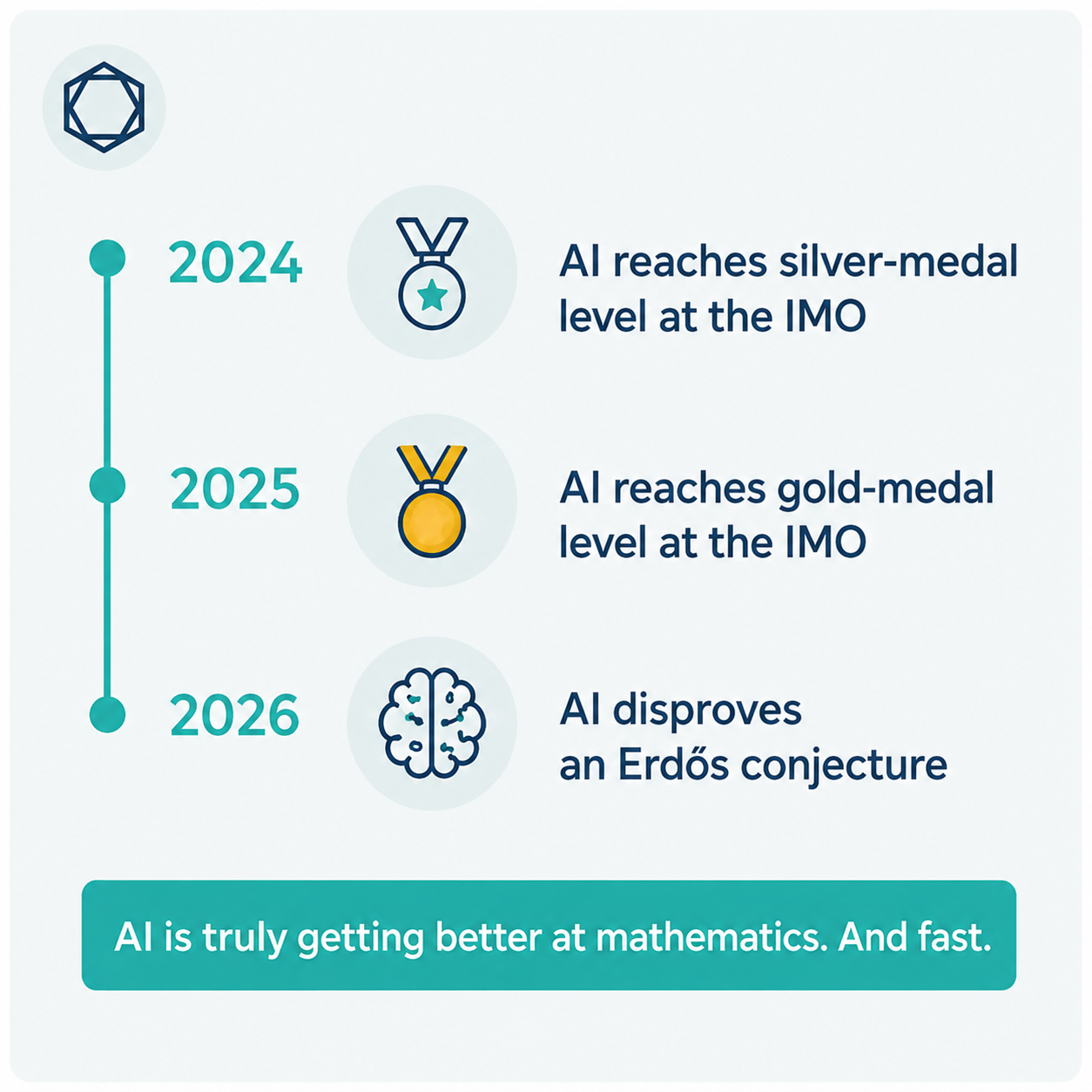
So we are no longer just talking about AI that can solve textbook exercises. AI is starting to contribute to real mathematical discoveries. That is impressive. And it would be strange for the education sector to be afraid of that.
The tutor of the future uses AI
That is why I think we are asking the wrong question when we ask:
“Will AI replace the tutor?”
The more interesting question is:
"How can a good tutor use AI to help students even better?"
A tutor can use AI to create extra exercises at the right level more quickly. To explain the same theory in three different ways. To prepare a lesson. To generate sample questions. Or to create a clear summary after the lesson.
The time saved can be spent on something AI finds much harder: listening, observing, motivating, and understanding why a particular student is struggling.
The same applies to students.
Feel free to use ChatGPT to explain a concept in a different way. Let AI create extra exercises. Ask why your reasoning is incorrect. Use it as a sparring partner while studying.
But also learn when to say:
"I can't figure this out. I need someone to take a look with me."
Anyone at that point can use Eduvik to submit a tutoring request for free and choose a suitable tutor themselves.
AI does not replace tutoring. It changes it.
AI is going to change education. I have little doubt about that.
And yes, certain questions for which a student might have needed a tutor in the past can now be perfectly answered by AI. That is not a threat. That is progress.
The value of a good tutor has never been solely in the possession of the right information. That information has been in books for decades, and on the internet for quite some time now.
The real value lies in personal guidance: seeing where someone is stuck, asking the right question, making difficult subject matter understandable, and giving a student confidence again when things aren't going well.
AI can be a fantastic assistant in this. For the student and for the tutor. But for now, I'm not leaving my students alone with ChatGPT just yet. 😉